By William S. Smith, Esq. (774) 317-9287
June 30, 2026 may ultimately be remembered as one of the most consequential days for the Second Amendment since the Supreme Court decided New York State Rifle & Pistol Association v. Bruen.
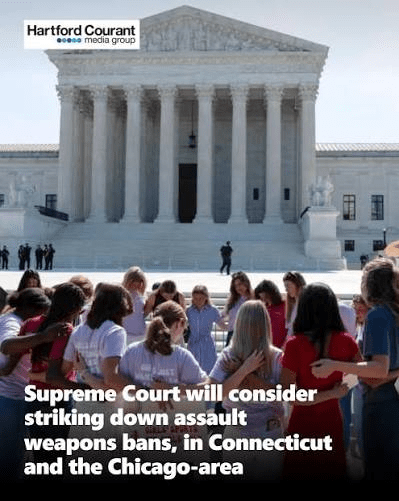
Today, the United States Supreme Court granted certiorari in Viramontes v. Cook County and Grant v. Higgins, agreeing to hear challenges to Illinois and Connecticut bans on commonly owned semiautomatic rifles often inaccurately labeled “assault weapons.” In Massachusetts law they are now even called “assault-style weapons.” The Court’s decision to take these cases signals that the Justices are finally prepared to answer one of the largest unresolved questions left open after Bruen: Can the government ban entire categories of firearms that millions of Americans lawfully own for self-defense and other lawful purposes?
For Second Amendment advocates, this is the case they have been waiting for.
What Does a Grant of Certiorari Mean?
When the Supreme Court grants certiorari, it agrees to review a lower court decision.
The Court receives thousands of petitions every year and hears only a tiny fraction of them. A grant of certiorari therefore carries enormous significance. It does not guarantee a particular outcome, but it does mean that at least four Justices concluded that the issue is important enough to warrant Supreme Court review.
In practical terms, the grant means:
- The Court will receive full briefing.
- Oral argument will likely occur during the upcoming Term.
- A nationwide precedent will ultimately be issued.
- Every state and federal court in America will be bound by the Court’s ruling.
The Supreme Court does not typically grant review merely to rubber-stamp lower court decisions. Historically, a grant often indicates that at least some Justices believe there is a substantial legal question requiring clarification or correction.
The Cases
Viramontes v. Cook County
Viramontes challenges Cook County, Illinois’ prohibition on semiautomatic rifles such as the AR-15. The Seventh Circuit upheld the ban, relying on reasoning that many Second Amendment advocates argue is fundamentally incompatible with Bruen. The challengers contend that these rifles are owned by millions of law-abiding Americans and are therefore protected “arms” under the Second Amendment.
Grant v. Higgins
Grant arises from nearby Connecticut’s sweeping prohibition on numerous semiautomatic rifles and related firearms. Connecticut’s law criminalizes possession of many rifles that would be legal in most of the country and has become one of the nation’s most aggressive examples of an “assault weapon” ban. Together, these cases present the Court with a direct opportunity to determine whether states may prohibit ownership of firearms that are undeniably common throughout the United States.
Why This Matters Under Bruen
The Supreme Court’s decision in Bruen established a simple but powerful constitutional test.
If the Second Amendment’s plain text covers the conduct at issue, the government bears the burden of proving that its restriction is consistent with the Nation’s historical tradition of firearm regulation.
Notably forbidden by Bruen was the old judicial practice of balancing constitutional rights against governmental interests. Courts may not simply conclude that a law promotes public safety and therefore survives constitutional scrutiny.
Instead, governments must point to historical analogues from the Founding Era. That burden has proven difficult in many modern firearms cases.
The central problem for states defending semiautomatic rifle bans is obvious: AR-15 style rifles and similar firearm platforms are among the most commonly owned firearms in America.
The Supreme Court has repeatedly emphasized that arms “in common use” for lawful purposes receive constitutional protection. If millions of Americans lawfully possess these firearms, the question becomes whether the government may nevertheless prohibit them merely because legislators dislike their characteristics.
That issue is now squarely before the Court.
Why Second Amendment Supporters Are Optimistic
There are several reasons gun-rights advocates view today’s development as extraordinarily encouraging.
First, the Court just this month doubled down on Bruen in a series of decisions expanding Second Amendment protections and rejecting aggressive state efforts to restrict lawful carry.
Second, several Justices have openly signaled interest in addressing semiautomatic rifle bans. Justice Kavanaugh, in particular, previously suggested that the Court would likely need to confront the issue in the near future.
Third, the lower courts have become deeply divided regarding how Bruen should be applied to firearm bans. Such conflicts are exactly the type of issue that often prompts Supreme Court intervention.
The Potential Earthquake in Massachusetts
For Massachusetts gun owners, the implications are potentially profound.
Massachusetts has some of the most restrictive firearm laws in the nation. Many of those restrictions target the same categories of semiautomatic firearms now at issue before the Supreme Court.
If the Court concludes that commonly owned semiautomatic rifles are protected arms under the Second Amendment, Massachusetts’ assault weapon regime could become invalidated overnight.
But the consequences may not stop there.
A strong decision in favor of the challengers would likely reinforce several broader constitutional principles:
1. Common Use Means Protection
A ruling that AR-15 style rifles are protected because they are commonly owned would severely undermine the argument that states may ban particular classes, models or platforms of firearms simply because legislators consider them unusually dangerous.
That reasoning could affect challenges to:
- Massachusetts so called “assault weapon” restrictions.
- Magazine-capacity restrictions.
- Certain firearm registration requirements.
- Future attempts to prohibit popular firearm platforms.
2. Bruen’s Historical Test Would Become Even Stronger
A pro-Second Amendment decision would further cement the principle that courts cannot engage in interest balancing when evaluating firearm restrictions.
This would be particularly significant in Massachusetts, where state officials frequently continue to try to justify firearm regulations by invoking generalized public-safety concerns, despite Bruen’s mandate to that the test is a hostorical one, not an interest balancing one.
Under Bruen, and potentially under an expanded ruling in Viramontes and Grant, public-safety arguments alone are insufficient. Historical tradition must carry the day.
3. Massachusetts’ “Unsuitability” Regime Could Face Increased Scrutiny
Although these cases do not directly concern licensing, a robust opinion emphasizing objective constitutional standards could have ramifications for challenges to Massachusetts’ discretionary licensing framework. I presently have a case challening this very thing at the Supreme Judicial Court- Pratt v. Westbrook.
One of the central themes emerging from the Supreme Court’s recent Second Amendment jurisprudence is distrust of vague governmental discretion. The Court has repeatedly indicated that constitutional rights cannot depend upon the subjective judgment of local officials.
That principle lies at the heart of ongoing challenges to Massachusetts’ suitability-based licensing provisions, including cases presently working their way through the courts.
Looking Ahead
No one yet knows how the Court will ultimately rule.
But one thing is certain: the Supreme Court has now chosen to answer a question it has avoided for years.
Can states ban some of the most popular rifles in America?
The answer will shape the future of the Second Amendment for decades.
For gun owners in Massachusetts, the stakes could hardly be higher. A decision striking down the Illinois and Connecticut bans would not merely affect those states. It could trigger a sweeping reexamination of Massachusetts firearm laws and accelerate constitutional challenges to restrictions that have long been considered untouchable.
Today was not the final battle.
But it may prove to be the beginning of one of the most important Second Amendment cases in modern American history.
 MA GUN LAWYER
Leave a comment