By Attorney William S. Smith (774) 317-9287
On June 25, 2026, the United States Supreme Court issued what may become one of the most important Second Amendment decisions since New York State Rifle & Pistol Association v. Bruen.
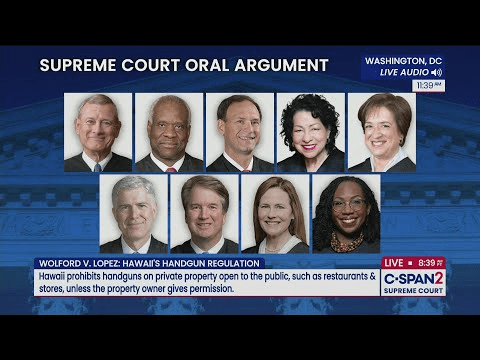
In Wolford v. Lopez, the Court struck down Hawaii’s law prohibiting licensed concealed carry holders from carrying firearms onto private property open to the public unless the property owner had affirmatively granted permission. The Court held that the law violated both the Second and Fourteenth Amendments because it fundamentally burdened the right of ordinary, law-abiding citizens to carry firearms for self-defense during the ordinary activities of daily life.
Although the immediate issue involved Hawaii’s “private property default rule,” the opinion reaches much farther. It strengthens Bruen, clarifies the proper standard of review in Second Amendment cases, rejects attempts by states to evade constitutional protections through creative legislative drafting, and sends a powerful warning to jurisdictions—including Massachusetts—that continue to rely upon highly discretionary firearms licensing schemes.
The Court Makes Clear: Bruen Was Not a One-Off
Justice Alito’s majority opinion reads almost like a reaffirmation—and expansion—of Bruen. The Court again explains that Second Amendment cases follow a straightforward two-step inquiry. First, courts ask whether the challenged law burdens conduct protected by the plain text of the Second Amendment. If it does, the law is presumptively unconstitutional.
The burden then shifts entirely to the government to prove that the restriction is consistent with the Nation’s historical tradition of firearm regulation through genuine historical analogues—not modern policy arguments or judicial balancing of competing interests. That language matters enormously.
Since Bruen, many lower courts have attempted to soften or narrow its methodology. Wolford leaves little room for that approach. The Court again rejects the sort of “interest-balancing” analysis that Heller condemned and stresses that constitutional rights cannot be diluted because judges believe public safety would be better served by broader governmental authority.
Constitutional Rights Do Not Change With Local Politics
One of the strongest passages in the opinion addresses Hawaii’s argument that its unique culture justified unique firearms regulations. The Court categorically rejected that proposition. Justice Alito wrote that the Second Amendment “cannot give way to the spirit of Aloha,” just as it cannot yield to “the spirit of the Big Apple” or “the Windy City.” Constitutional rights have the same meaning throughout the United States, and local political preferences cannot shrink or expand the protections guaranteed by the Bill of Rights. That reasoning carries obvious significance for Massachusetts.
For decades, Massachusetts officials have defended restrictive licensing practices on the ground that the Commonwealth has chosen a more aggressive approach to gun regulation. Wolford reiterates that the Fourteenth Amendment incorporates the Second Amendment as a uniform national guarantee, not one that changes from Boston to Boise.
Bruen Already Pointed Toward Massachusetts
Perhaps what will become one of the most overlooked portions of the opinion is the Court’s reminder that Bruen itself identified six jurisdictions—including Massachusetts—that maintained licensing systems similar to New York’s unconstitutional “proper cause” regime. The majority specifically recalls that observation when describing how several states attempted to preserve broad restrictions on carrying firearms after Bruen by adopting new regulatory mechanisms.
That reminder is significant because Bruen itself stated:
“…because any permitting scheme can be put toward abusive ends, we do not rule out constitutional challenges to shall-issue licensing regimes where, for example, lengthy wait times or exorbitant fees deny ordinary citizens their right to public carry.”
Even more importantly for Massachusetts, Bruen specifically observed that several states—including Massachusetts—combined objective licensing criteria with vague “suitability” provisions that left substantial discretion in licensing officials’ hands. The Court noted that such discretionary provisions could themselves present constitutional problems notwithstanding the existence of a nominally “shall issue” licensing framework.
Wolford reinforces that warning rather than retreating from it.
What This Means for Massachusetts’ “Unsuitability” Law
No state may feel the implications of Wolford more acutely than Massachusetts. The Commonwealth continues to authorize licensing authorities to deny or suspend firearms licenses whenever they conclude that an applicant or license holder is “unsuitable” or “may create a risk to public safety.”
Those standards remain strikingly and appallingly subjective.
Unlike traditional historical disqualifications—such as felony convictions or demonstrated dangerousness—they permit officials to rely upon broad predictive judgments, uncharged allegations, dismissed accusations, hearsay, decades-old incidents, or simply differing views regarding an individual’s character. That type of open-ended discretion is precisely what animated the Supreme Court’s concern in Bruen.
Wolford further strengthens that concern today.
Throughout the opinion, the Court repeatedly emphasizes that constitutional rights cannot depend upon the discretionary judgments of government officials or upon modern policy preferences unsupported by historical tradition. If Hawaii cannot burden the right to carry through a novel default-property rule lacking historical support, Massachusetts will face an increasingly difficult task explaining how an amorphous “unsuitability” determination fits within the historical tradition required by Bruen and reaffirmed in Wolford. The same reasoning applies equally to both initial license denials and subsequent suspensions.
Whether the Commonwealth refuses to issue a license or later suspends (an indefinite status, by the way) revokes one, the constitutional question remains identical: Has the government identified a historically grounded basis for depriving a law-abiding citizen of the right to bear arms? Generalized assertions of “public safety” are no longer going to satisfy the historical inquiry that Bruen and now Wolford require.
The Standard of Review Just Became Even More Important
One of the most consequential aspects of Wolford concerns how courts are supposed to evaluate Second Amendment claims. The majority repeatedly describes laws burdening protected conduct as presumptively unconstitutional once they fall within the plain text of the Second Amendment. The government—not the citizen—must then justify the restriction through historically analogous regulations. The Court again rejects the balancing of governmental interests against constitutional rights as an improper mode of analysis.
For pending Massachusetts litigation challenging the Commonwealth’s licensing laws- my own case Pratt v. Westbrook at the Massachusetts Supreme Judicial Court- that clarification is especially significant. Courts reviewing “unsuitability” determinations should not begin from a position of deference to administrative judgments about public safety. Rather, under the framework reaffirmed in Wolford, the constitutional inquiry begins with the protected right itself, and the Commonwealth bears the burden of demonstrating that its licensing standard reflects the historical tradition of firearm regulation recognized at the Founding or Reconstruction. That allocation of the burden may prove outcome-determinative in many future cases.
The Dissents Reveal What May Be Coming
Equally significant are the three dissenting votes. Justice Kagan authored one dissent. Justice Jackson wrote another, joined by Justice Sotomayor. To put it mildly, together, the dissents reveal a fundamentally different vision of the Second Amendment than that adopted by the Court’s majority.
Although each dissent approaches the issue differently, all three Justices would have upheld Hawaii’s law. More broadly, the dissents reflect continuing skepticism toward the history-and-tradition framework established in Bruen and reaffirmed in Wolford. They favor giving substantially greater latitude to legislatures in addressing modern public-safety concerns than the majority permits.
That divide has profound implications.
The constitutional protections recognized in Heller, McDonald, Bruen, Rahimi, and now Wolford exist because a majority of the current Court accepts the proposition that the Second Amendment protects an enforceable individual right that cannot be subordinated to judicial assessments of policy or public safety. If a future Court were to embrace the philosophy reflected in the dissents, the analytical framework governing Second Amendment cases would change dramatically.
For states such as Massachusetts, California, New York, New Jersey, and Hawaii—jurisdictions that have repeatedly sought to preserve broad regulatory discretion after Bruen—such a shift could substantially increase the likelihood that expansive firearms regulations would survive constitutional challenge.
Looking Ahead
Wolford should not be viewed as merely another “carry case.” Instead, it represents the Supreme Court’s continued insistence that the Second Amendment be treated like every other constitutional guarantee.
The Court again rejected interest balancing. It again emphasized that constitutional rights are national rights. It again reaffirmed that governments—not citizens—carry the burden of justifying restrictions.
And it again demonstrated that states cannot evade Bruen simply by inventing new mechanisms that accomplish the same practical result as laws the Constitution forbids. For Massachusetts, the message is unmistakable.
Whether the issue is sensitive-place designations, discretionary licensing practices, or the Commonwealth’s expansive “unsuitability” standard, Wolford provides substantial new authority supporting the proposition that vague governmental discretion is increasingly difficult to reconcile with the Supreme Court’s modern Second Amendment jurisprudence.
The next major chapter in that debate may well be written in cases challenging Massachusetts’ own licensing laws- most notably my Pratt v. Westbrook case.
If Wolford is any indication, those challenges now stand on even firmer constitutional ground.


Leave a Reply