By William S. Smith, Esq. http://www.attorneysmithlaw.com (774) 317-9287
If, like me, you litigate Second Amendment cases in Massachusetts with any regularity, you quickly notice a pattern. Whether the case involves a criminal firearms prosecution, a License to Carry (LTC) suspension, an LTC denial, or another firearms-related matter, government lawyers (criminal prosecutors and those lawyers representing firearms license authorities) almost invariably fall back on the same two familiar talking points:
- “The Second Amendment is not absolute.”
- “The government is not saying that you cannot own a firearm, so the Second Amendment is not implicated.”
These statements are repeated so frequently that they have become almost reflexive. They are often offered as though they end the constitutional analysis before it even begins.
They do not.
In fact, if either proposition were accepted as a valid legal principle, virtually every constitutional right contained in the Bill of Rights would become little more than an empty promise.
“The Second Amendment Is Not Absolute”
Let’s begin with the first claim.
Of course the Second Amendment is not absolute.
Neither is the First Amendment.
Nor the Fourth Amendment.
Nor the Fifth Amendment.
Nor the Sixth Amendment.
Nor virtually any constitutional guarantee. No serious constitutional lawyer disputes this. But that observation proves absolutely nothing.
Imagine if a prosecutor defended censorship by arguing:
Well, the First Amendment isn’t absolute.”
Or defended a warrantless search by saying: “The Fourth Amendment isn’t absolute.” Or justified denying counsel to an accused by asserting that “The Sixth Amendment isn’t absolute.”
Every judge would immediately recognize that these statements merely begin the constitutional inquiry—not end it. Any alert, fair-minded judge would respond by reminding counsel that just because nothing is “absolute” it hardly follows that every governmental action short of its immediate eradication is constitutionally-permissible.
The relevant question is not whether a constitutional right is absolute.
The relevant question is whether a particular governmental restriction is constitutionally permissible.
That requires constitutional analysis.
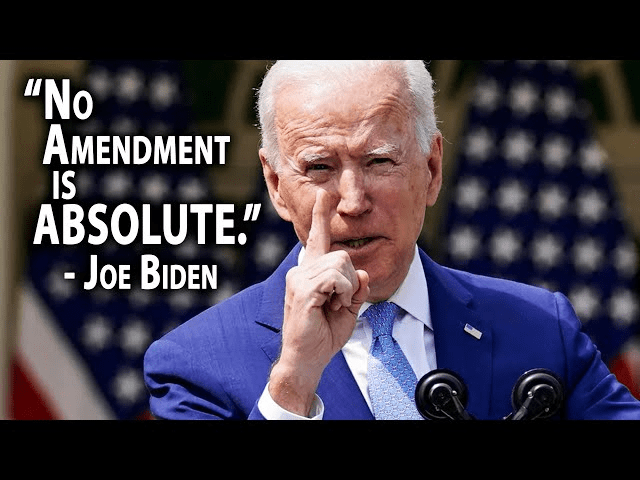
Simply announcing that “the Second Amendment is not absolute” is no substitute for doing the work required by the Constitution. Even when presidents like the one shown below advance this grossly oversimplified, straw man argument via teleprompter, it does not make it any more palpable.
The Second Platitude Is Even Worse
Even more troubling is the increasingly common assertion that because the government is not completely prohibiting firearm ownership, the Second Amendment somehow is not implicated.
The argument typically sounds something like this: “The defendant can still own firearms somewhere.”
Or, as I often hear, “Your Honor, the licensing authority isn’t saying he can never possess a firearm.” And this despite the fact that LTC “suspensions” and denials are indefinite and left to the exclusive whim of a chief of police.
Therefore, according to this theory, there is supposedly no Second Amendment issue.
That reasoning would never be accepted in any other constitutional context.
Imagine Applying This Logic to Free Speech
Suppose Massachusetts enacted a law prohibiting criticism of state officials on Facebook.
The Commonwealth then argues:
“The First Amendment isn’t implicated because you can still speak in your own living room.”
Would anyone accept that argument? Would any judge?
Of course not.
Or suppose the government prohibited political speech in newspapers but permitted citizens to whisper their opinions to friends.
Would anyone conclude that free speech had not been burdened?
Again, no.
The First Amendment protects far more than the mere existence of some theoretical ability to speak somewhere.
It protects meaningful exercise of the right.
Restrictions on speech trigger constitutional scrutiny even when they fall far short of a complete ban.
No one would seriously contend that the government may censor books, websites, social media, campaign literature, or public demonstrations simply because citizens remain free to speak privately at home.
Yet remarkably, this is essentially the argument that is repeatedly advanced with respect to the Second Amendment in the Commonwealth of Massachusetts daily.
Constitutional Rights Are Not All-or-Nothing
The Bill of Rights has never been interpreted as protecting only total prohibitions.
Government restrictions that burden constitutional rights—even partial burdens—are routinely analyzed under constitutional standards.
A restriction on speech.
A restriction on assembly.
A restriction on religious exercise.
A restriction on searches.
A restriction on counsel.
All implicate constitutional protections.
The same is true for restrictions on keeping and bearing arms.
The Second Amendment is not triggered only when the government confiscates every firearm or enacts a complete prohibition on ownership.
It protects against unconstitutional burdens on the exercise of the right itself.
That principle is indeed central to modern Second Amendment jurisprudence.
The Supreme Court Has Already Rejected This Approach
The Supreme Court’s Second Amendment decisions make clear that the constitutional inquiry does not begin and end with whether someone may own some firearm somewhere.
The Court has repeatedly emphasized that the Second Amendment protects an individual constitutional right that cannot be treated as a second-class guarantee.
Like other constitutional rights, burdens on that right require constitutional justification.
Whether the issue involves licensing, possession restrictions, carrying firearms, location-based prohibitions, or other limitations, the proper question is whether the government can justify the restriction under the governing constitutional framework—not whether it stopped short of a total prohibition.
Reducing the Second Amendment to nothing more than a protection against an outright statewide firearm ban ignores what the Supreme Court has actually said.
I Recently Heard These Exact Arguments
What makes these arguments especially frustrating is that they are not merely academic.
At a recent court hearing in a Massachusetts criminal firearms prosecution, I listened as a prosecutor advanced these very propositions.
The prosecutor argued, in substance, that because the Second Amendment is “not absolute,” and because the Commonwealth was not by way of the law at issue banning gun ownership, the constitutional issues simply disappeared, or were not ever present to begin with.
Those arguments were presented not as passing observations, but as though they resolved the constitutional analysis entirely.
They do not.
Indeed, if accepted, the same reasoning could be used to diminish virtually every constitutional guarantee in the Bill of Rights.
The Second Amendment Deserves the Same Respect as Every Other Constitutional Right
The Supreme Court has repeatedly emphasized that the Second Amendment is not a “second-class right.”
Yet in Massachusetts litigation, it is often treated exactly that way.
Imagine a courtroom where government lawyers routinely defended restrictions on speech by simply declaring that the First Amendment is “not absolute.”
Or where Fourth Amendment violations were excused because citizens remained free from unreasonable searches most of the time.
Such arguments would be dismissed almost immediately.
The Second Amendment deserves no less.
Constitutional rights are not protected only when government eliminates them entirely.
They are protected whenever government burdens them in a manner inconsistent with the Constitution.
The next time someone responds to a Second Amendment challenge with the familiar refrain that “the Second Amendment is not absolute” or “you can still own a firearm,” remember that these are not constitutional arguments.
They are, at best, slogans.
At worst, they are a window into the soul of how Massachusetts audaciously continues to treat this particular provision of the Bill of Rights.


 MA GUN LAWYER
Leave a comment