By Attorney William S. Smith
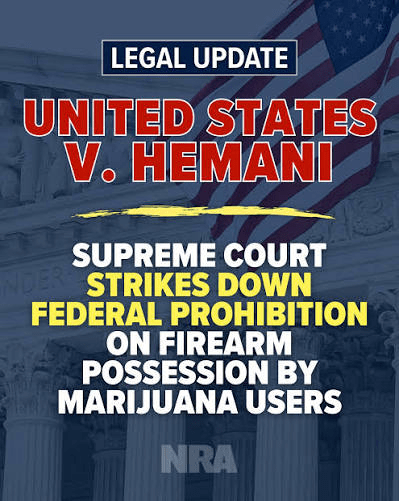
On June 18, 2026, the United States Supreme Court issued its unanimous decision in United States v. Hemani, delivering yet another significant victory for Second Amendment rights and further clarifying the constitutional limits on firearm disqualifications based upon broad legislative classifications. The Court held that the federal government could not constitutionally apply the federal “unlawful user of a controlled substance” firearms prohibition to Ali Hemani, a Texas resident and marijuana user, because the government failed to demonstrate that disarming him was consistent with the Nation’s historical tradition of firearm regulation or that he posed the type of danger historically associated with firearm prohibitions. Justice Neil Gorsuch authored the Court’s opinion.
While the Court stopped short of completely invalidating 18 U.S.C. § 922(g)(3), the decision dramatically narrows the government’s ability to impose categorical firearm prohibitions upon entire classes of individuals without individualized proof of dangerousness. The ruling represents another step in the Supreme Court’s ongoing effort to enforce the principles first announced in New York State Rifle & Pistol Association v. Bruen, namely that the government may not restrict the right to keep and bear arms merely because legislators believe doing so is good policy. Rather, the government must demonstrate that a challenged restriction is consistent with the historical understanding of the Second Amendment.
The End of “Status-Based” Disarmament?
Perhaps the most important aspect of Hemani is the Court’s rejection of the government’s argument that it could disarm a person simply because he fit within a legislatively created category.
The government argued that anyone who qualifies as an “unlawful user” of a controlled substance may automatically be stripped of Second Amendment rights. The Court rejected that sweeping proposition, emphasizing that constitutional rights cannot be extinguished merely because an individual falls into a broad status category. Instead, the government must demonstrate a constitutionally sufficient basis for disarmament.
That principle may have profound implications far beyond federal drug-user prosecutions.
What Does Hemani Mean for Massachusetts’ Lifetime Firearms Disqualification Based on Any Controlled Substance Conviction?
Massachusetts law currently imposes a firearms disability upon persons convicted of virtually any controlled substance offense, regardless of how old the conviction may be, how minor the offense was, or whether the offense involved violence. A decades-old possession conviction can permanently prevent an otherwise law-abiding citizen from obtaining a License to Carry (“LTC”) or Firearms Identification Card (“FID”).
After Hemani, that scheme appears increasingly difficult to reconcile with the Supreme Court’s Second Amendment jurisprudence.
The central lesson of Hemani is that the government may not rely upon broad assumptions that all members of a particular class are dangerous. The Court instead focused on individualized dangerousness and historical tradition.
Massachusetts’ controlled-substance disqualification suffers from many of the same constitutional defects identified in Hemani. The Commonwealth effectively presumes that every person who has ever been convicted of a drug offense is permanently unfit to exercise a constitutional right. Yet there is little historical evidence from the Founding Era supporting the permanent disarmament of nonviolent citizens merely because of prior drug-related conduct.
Indeed, many Massachusetts firearms applicants are denied based upon convictions that occurred decades earlier and have no connection whatsoever to violence, firearm misuse, or public safety concerns. Under the logic of Hemani, courts may increasingly ask whether the Commonwealth can constitutionally impose such a sweeping disability without proving that the particular individual presents a genuine danger.
The question becomes even more pressing as more states move toward legalization or decriminalization of marijuana and other drug offenses. The notion that a minor controlled-substance offense should permanently extinguish a fundamental constitutional right appears increasingly difficult to defend under the Court’s current Second Amendment framework.
Hemani and the Massachusetts “Unsuitability” Standard
The implications for Massachusetts’ notorious “unsuitability” law may be even more significant.
Massachusetts remains one of the few states that authorizes licensing authorities to deny, suspend, or revoke firearms licenses based upon a highly subjective determination that an applicant is “unsuitable” or may pose a future public-safety risk.
Although recent statutory amendments attempted to define unsuitability, the law still permits licensing authorities to suspend or deny constitutional rights based upon predictions, allegations, hearsay, and highly discretionary judgments that often have little relationship to actual dangerousness.
The constitutional vulnerability of the unsuitability framework has become increasingly apparent since Bruen. Hemani adds another powerful argument against such discretionary systems.
The Supreme Court’s opinion repeatedly emphasized that constitutional rights cannot be denied based merely upon generalized assumptions about a category of persons. Rather, government action must be tied to constitutionally recognized historical justifications and actual evidence supporting disarmament.
That reasoning cuts directly against the core logic underlying Massachusetts unsuitability determinations.
In many Massachusetts cases, licenses are denied or suspended not because the license holder committed a disqualifying offense, but because a police chief concludes that the individual might pose a risk in the future. Frequently those determinations rely on allegations that never resulted in criminal charges, accusations that were dismissed, civil disputes, old incidents, or conduct that would not independently justify disarmament under any historical tradition.
If the federal government cannot automatically disarm a marijuana user without proof that the individual fits within a historically recognized category of dangerous persons, it becomes increasingly difficult to justify a system that allows local officials to revoke constitutional rights based on subjective predictions of future risk.
The constitutional challenge currently pending before the Massachusetts Supreme Judicial Court in my case, Pratt v. Westbrook, squarely raises many of these issues. Hemani will undoubtedly become an important case in that ongoing debate.
The Bigger Picture
The broader significance of Hemani is that the Supreme Court continues moving toward a principle that many lower courts have resisted since Bruen: the Second Amendment protects ordinary, peaceable citizens, and the government bears the burden of proving why a particular person may be disarmed.
For decades, firearm regulations often survived judicial review because courts deferred to legislative judgments about public safety. The Court’s modern Second Amendment decisions increasingly reject that approach.
Hemani reinforces a different constitutional rule. The government cannot simply point to a legislative label and declare that a constitutional right disappears. It must establish that the challenged restriction fits within America’s historical tradition of firearm regulation and that the individual being disarmed falls within a constitutionally permissible category.
For Massachusetts firearm owners, LTC applicants, and those challenging denials or suspensions based upon old controlled-substance convictions or subjective unsuitability determinations, today’s decision represents another indication that the constitutional landscape continues to shift dramatically in favor of individual rights.
The Supreme Court has not yet answered every question. But one message from Hemani is unmistakably clear: broad, categorical firearm prohibitions based on status alone are becoming increasingly difficult to reconcile with the Second Amendment.
 MA GUN LAWYER
Leave a comment