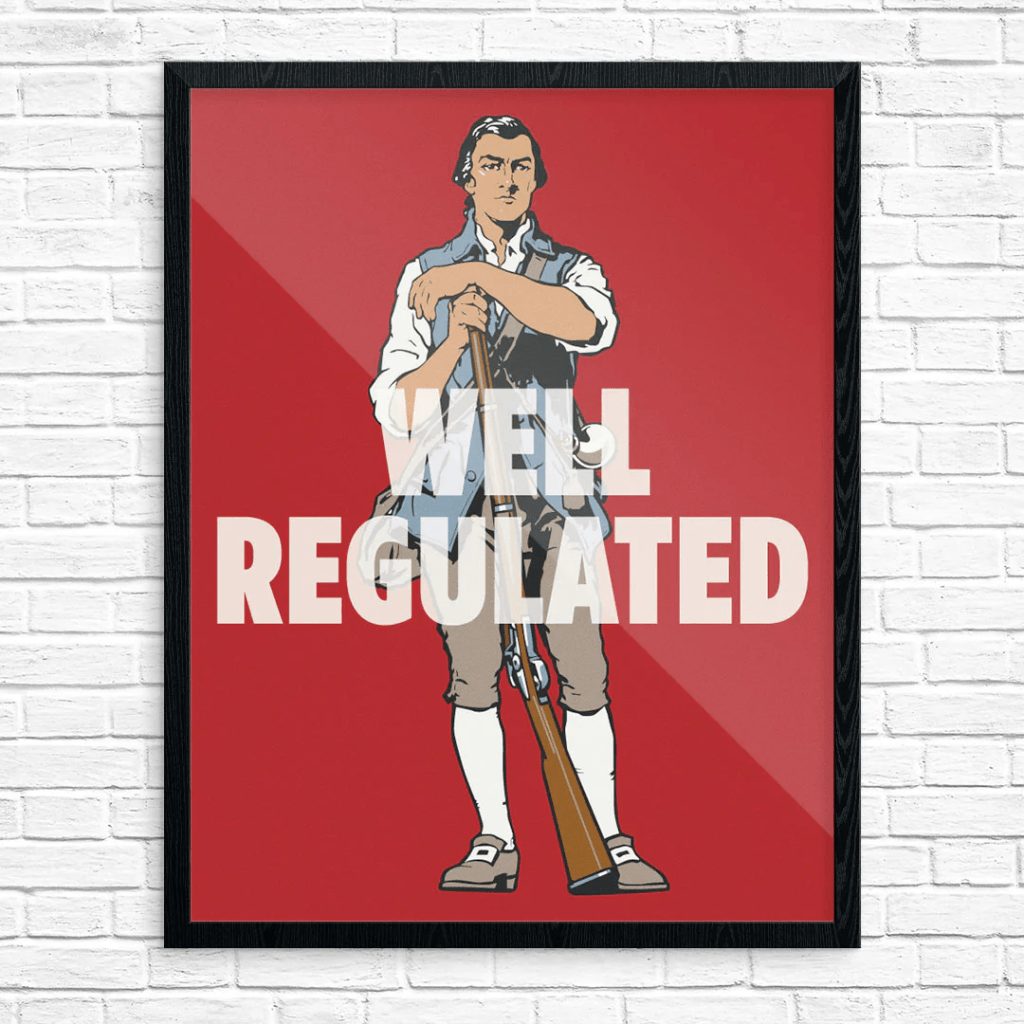
When the Massachusetts Supreme Judicial Court in Worcester Police Chief v. Holden in 2015 declared that, “The prefatory clause of the Second Amendment (‘well regulated Militia’) anticipates some regulation,” it echoed a modern, fundamental misunderstanding that has continued to creep into constitutional discourse — the belief that the word “regulated” in 18th-century America meant “subject to government control.”
That view is not only historically inaccurate — it inverts the very purpose and spirit of the Amendment itself.
What “Well Regulated” Really Meant in 1791
To the Framers and their contemporaries, “well regulated” did not mean “heavily supervised by the government.”
The word “regulate” in 18th-century usage referred to something being in proper working order — disciplined, trained, and effective.
A “well regulated clock” kept good time; a “well regulated mind” was steady and self-disciplined; and a “well regulated militia” was one that was well trained and properly equipped, not one hamstrung by bureaucracy.
This interpretation is confirmed by the language of the period.
In 1789, Samuel Johnson’s Dictionary — the standard reference of the day — defined “to regulate” as “to put in good order.”
And when George Washington wrote of the need for a “well regulated militia,” he meant a citizen soldiery that practiced regularly, kept their arms in readiness, and maintained discipline — most assuredly not one whose firearms were rationed or licensed by the state.
The Framers’ Vision: An Armed Citizenry, Not a Controlled One
The Founders feared standing armies precisely because such forces were tools of central power.
The militia was the constitutional counterweight — the people themselves, armed and organized locally, serving as the ultimate check on tyranny.
To suggest that “well regulated” authorizes the never-ending governmental limits on the people’s right to possess arms in Massachusetts flips this logic on its head.
It turns the safeguard of liberty into a mechanism for control.
In Federalist No. 29, Alexander Hamilton wrote that a “well regulated militia” was composed of “citizens with arms in their hands, officered by men chosen from among themselves.”
That vision presumes private ownership and competence — not permission slips or prior restraint.
The militia was to be “regulated” by training and readiness, not by restriction or disarmament.
A Modern Linguistic Trap
When courts like the SJC read “regulated” through today’s administrative lens — the same lens that governs environmental codes and zoning ordinances — they impose a modern bureaucratic meaning that did not exist in 1791.
It’s a linguistic sleight of hand: retrofitting a 20th-century regulatory state vocabulary into an 18th-century charter of individual liberty.
The result is a distortion of both grammar and history.
The prefatory clause — “A well regulated Militia, being necessary to the security of a free State” — is not a license for regulation but a statement of purpose.
It explains why the right was codified: because a disciplined citizen militia is vital to a free state.
The operative clause — “the right of the people to keep and bear Arms, shall not be infringed” — protects that means of maintaining freedom.
The Founders’ Context: Regulation by Virtue, Not by Bureaucracy
Eighteenth-century Americans understood civic order as something rooted in virtue and self-governance, not in administrative control.
A “well regulated” militia was one in which citizens exercised discipline — self-regulation — in service to the republic.
It required a populace trained in arms and ready to defend liberty, not one dependent on a licensing officer to grant conditional permission.
Therefore, when modern courts like the SJC interpret “well regulated” as endorsing “some regulation,” they ignore that the militia clause anticipates readiness, not restriction.
The Framers’ goal was not to empower government to manage citizens’ arms, but to ensure that citizens themselves remained capable of defending their own liberty.
Conclusion: Restoring Original Meaning to a Misused Phrase
The SJC’s assertion that the Second Amendment “anticipates some regulation” may sound superficially reasonable — but it rests on a false premise.
The Amendment’s prefatory clause celebrates a citizenry competent in arms, not one controlled by administrative rules.
To read “regulated” as “restricted” is to misread the Founders entirely.
History shows that a “well regulated militia” was one that was well trained, self-disciplined, and independent — the very opposite of a people whose rights exist only at the pleasure of the state.
Similarly, I have read more times in court decisions, the SJC’s included, the platitude that “the Second Amendment right is not unlimited,” etc. I have seen no other Constitutional right so frequently tethered to this ultimately uninstructive platitude.
Why is the Second Amendment so frequently defined by the courts, not as what regulation and governmental action it forbids, but what it allows?
The US Supreme Court said otherwise in Bruen. It said specifically no, this is not a second-class Constitutional right.
I wonder when the lower courts will finally come to understand that it meant what it said?


 MA GUN LAWYER
Leave a reply to festivalwondrous3a888d43f9 Cancel reply