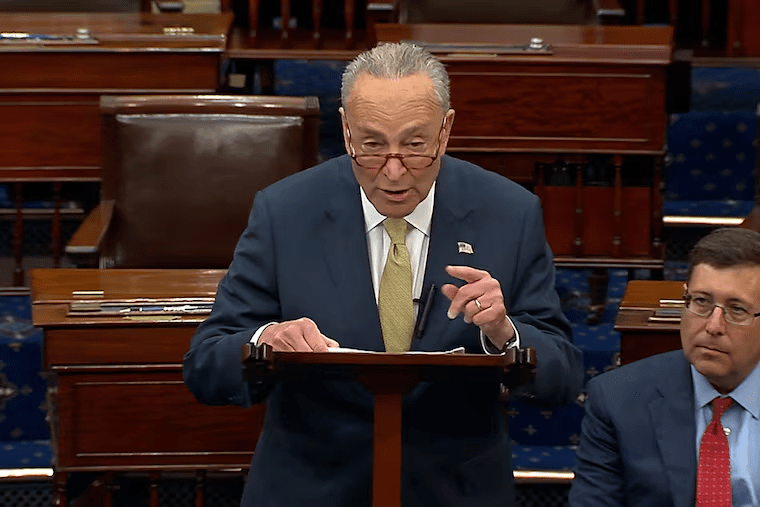
On January 28, 2026 Senator Chuck Schumer took to the Senate floor and—of all things—invoked the Second Amendment as a rhetorical shield.
He said: “The President seems to have forgotten the words of the Second Amendment … ‘the right of the people to keep and bear Arms, shall not be infringed.’”
If you’ve followed Schumer’s actual legislative record, the whiplash is immediate. For decades, he has treated the Second Amendment less like a constitutional guarantee and more like a policy problem to be “managed” (regulated out of existence)—typically by expanding federal gatekeeping, tightening ownership rules, and reviving bans that directly burden common, law-abiding, peaceful possession. So when he suddenly quotes “shall not be infringed” as if it’s a principle he’s been defending all along, it lands as appallingly naked political convenience—not constitutional consistency.
The glaring hypocrisy: quoting “shall not be infringed” while literally building infringement-as-policy
Schumer’s 2026 floor argument was essentially: you can’t treat gun rights as contingent on political loyalty. That point—stripped of partisan packaging—is true in a constitutional republic. Rights aren’t just “for good people” as defined by the party in power.
But here’s the problem: Schumer’s own career has been built around precisely the opposite instinct—that the right can be narrowed, delayed, conditioned, and prohibited whenever his preferred policy coalition says so. And not just in speeches, but in the most concrete way possible: votes and bills.
A (career-spanning) list of major anti-2A legislation Schumer has voted for, sponsored, or supported as documented in public voting records
- Brady Handgun Bill (1993) — Voted Yes on the Brady framework (waiting period/background-check architecture).
- Regulation of Semi-Automatic “Assault Weapons” (1994) — Voted Yes on legislation regulating/banning covered semi-automatic firearms.
- Gun Show Sale Regulation Amendment (1999) — Voted Yes on regulating gun show sales.
- Firearms Manufacturers Protection Bill (2004) — Voted No on protections for firearms manufacturers (liability-related context).
- Allowing Loaded Guns in National Parks (2009) — Voted No on allowing loaded firearms in national parks.
- Authorizing Concealed Firearms Across State Lines (2009) — Voted No on concealed-carry reciprocity.
- Prohibits Sale of Assault Weapons (2013) — Voted Yes on an assault-weapon prohibition effort.
- Limits Firearm Magazine Capacity (2013) — Voted Yes on magazine-capacity limits.
- Terror-related firearm restrictions (2015–2016) — Voted Yes on multiple proposals aimed at restricting transfers to suspected terrorists / “no-fly, no-buy” style approaches (and related amendments).
- Fix Gun Checks Act of 2016 (amendment vote context) — Voted Yes in support of “fix gun checks”/background-check expansion efforts.
- Bipartisan Safer Communities Act (2022) — Voted Yes on passage.
Sponsorship / cosponsorship (selected major federal gun-control bills)
- Assault Weapons Ban of 2023 (S.25) — Supported/associated with a modern federal “assault weapons” ban proposal in the 118th Congress.
- Assault Weapons Ban of 2021 (S.736) — Cosponsored the 2021 version.
- Assault Weapons Ban of 2025 (S.1531) — Cosponsored the 2025 version.
- Background-check expansion / “universal checks” efforts — Cosponsorship recorded for background-check expansion legislation in the current Congress cycle.
- Fix Gun Checks Act of 2016 (bill framework) — Background-check system expansion/“fix NICS” style legislation.
- House-origin background-check expansion bills (examples) — e.g., “Bipartisan Background Checks Act” model bills that establish new requirements for private transfers (illustrative of the policy approach Schumer has repeatedly pushed Senate Democrats to advance).
Why the 2026 quote still matters—and why it’s fair game to use it against him
When a political leader quotes the Second Amendment’s operative clause on the Senate floor, they’re not just scoring a point—they’re implicitly claiming fluency in the principle.
But Schumer’s decades-long pattern has been:
- Ban classes of commonly owned arms (repeated “assault weapons” ban pushes).
- Cap magazines by legislative fiat.
- Nationalize carry and possession rules in ways that trend one direction: tighter, narrower, more draconian and Massachusetts-like.
- Expand background-check burdens beyond retail sales into private transfers (with criminal penalties as enforcement).
So yes—if Schumer wants to deploy “shall not be infringed” as a talking point in 2026, gun-rights advocates are fully justified in responding:
Fine. Then live by it.
Stop sponsoring ban after ban. Stop treating ordinary possession as suspicious. Stop making the exercise of a constitutional right contingent on paperwork, permissions, and in manifestly political fashion. Stop suggesting that peaceful gun owners are the problem, not violent criminals.
That’s the real test. And it’s exactly why this moment—odd as it is—must not be forgotten.
 MA GUN LAWYER
Leave a comment