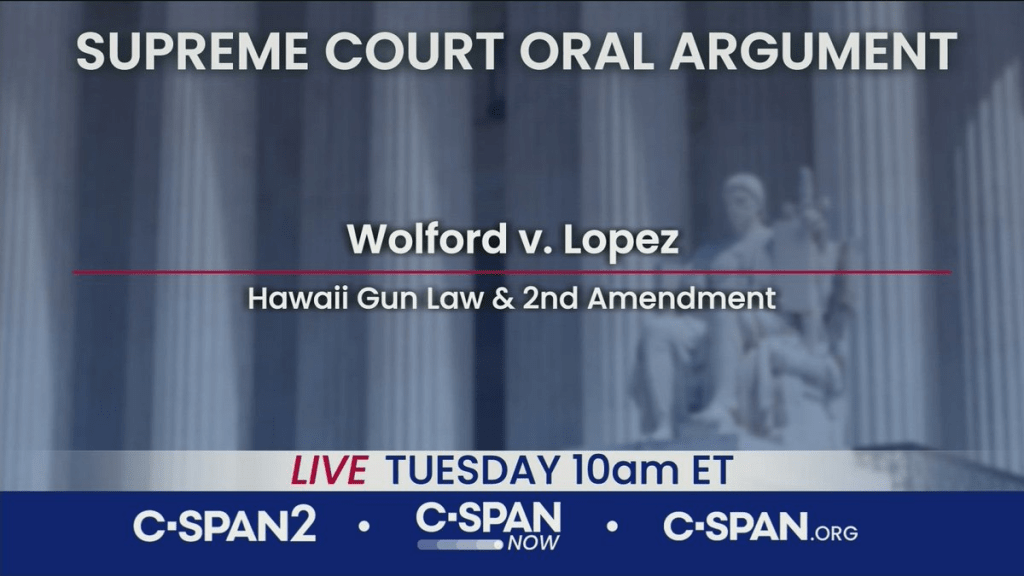
The US Supreme Court’s oral arguments today in Wolford v. Lopez made one thing unmistakably clear to me: Hawaii’s so-called “consent” regime for carry is not a neutral property rule. It is a calculated end-run around Bruen—a system designed to look like regulation but function like prohibition.
Under Hawaii’s law, lawful concealed carry is presumptively banned on nearly all private property open to the public unless the owner gives express permission. That means that shopping centers, grocery stores, gas stations, restaurants, laundromats, and countless other everyday locations are effectively off-limits—unless the business owner affirmatively opts in.
This isn’t regulation. It’s eradication.
As Petitioners’ counsel explained, Hawaii’s statute flips the historical default. Traditionally, when property is open to the public, entry is presumed lawful unless the owner objects. Hawaii inverts that rule for one constitutional right—and one alone: the right to bear arms. This inversion is not an incidental consequence.
It is the very point of this law.
A Ban in Everything But Name
During argument, the Justices confronted the uncomfortable truth: when carry is banned almost everywhere people actually go, the right itself becomes meaningless.
Petitioners’ counsel explained that Hawaii’s carry restrictions, taken as a whole, bar lawful carry on approximately 96.4% of land in Maui County. Even if that number is debated, the broader point remains devastating: a right that can only be exercised in a handful of remote or impractical locations is not a right at all.
This is exactly what Bruen forbade.
Bruen did not say states could “technically” allow carry while functionally banning it. It did not say states could replace a “may issue” licensing scheme (Hawaii, Massachusetts or anywhere else) with a “may exist” geography. The right recognized in Bruen is a right to public carry—not theoretical carry, not symbolic carry, but actual, functional carry.
Hawaii’s law guts that right by redefining nearly all public life as off-limits.
Property Rights as a Pretext
One of Hawaii’s main defenses is that this is really a “property law” case, not a Second Amendment case. But as the United States explained in its amicus argument, this framing is a smokescreen.
If Hawaii truly cared about property rights, it would regulate all potentially dangerous instruments similarly. But it doesn’t. The law singles out firearms—and only firearms—and burdens only licensed carriers. Hunters, target shooters, and others may still bring weapons onto private property without express consent. That asymmetry exposes the statute’s true purpose: not protecting property owners, but suppressing carry.
This kind of selective targeting is not neutral. It is pretextual.
And historically, pretextual regulations were precisely what the Second Amendment was meant to forbid. As the government pointed out, Blackstone and early American jurists recognized that laws could “infringe” a right not just by outright banning it, but by burdening it under false pretenses.
Why Hawaii’s Historical Analogues Fail
Hawaii relies heavily on 18th- and 19th-century “antipoaching” laws and Reconstruction-era Black Codes to justify its statute. But these analogies collapse under scrutiny.
First, antipoaching laws regulated closed private land, not commercial property open to the public. They addressed trespass, not public self-defense.
Second—and more troubling—some of Hawaii’s best analogues are openly racist Black Codes enacted to disarm freed slaves. Petitioners correctly argued that such discriminatory statutes cannot serve as legitimate historical benchmarks for modern constitutional analysis.
If the best historical support for a modern gun law is a law designed to disarm newly freed Black Americans, that law is not “rooted in tradition.” It is rooted in disgraceful racial oppression.
The Massachusetts Parallel: A Warning Shot
Massachusetts should be paying close attention.
Recent Massachusetts legislation that fortunately did not become law adopted a framework eerily similar to Hawaii’s—presumptively banning carry on vast categories of private property unless the owner explicitly opts in. Like Hawaii’s law, it weaponizes silence. Like Hawaii’s law, it converts default permission into default prohibition.
And like Hawaii’s law, it threatens to render lawful carry practically impossible.
Massachusetts has long used discretionary licensing to suppress the right to bear arms. Bruen struck that system down. The Commonwealth’s response appears to be geographic discretion instead: you may carry, but nowhere that matters.
This is the same shell game Hawaii is playing.
The Stakes: Whether Rights Can Be Nullified by Redefinition
If Hawaii’s law stands, no right is safe.
A state could say you may speak freely—just not on any private property open to the public without express permission. Or you may distribute pamphlets—just not in shopping centers, sidewalks, or parking lots unless a sign says you can. Or you may worship—just not in any building unless the owner posts approval.
Constitutional rights cannot depend on a scavenger hunt for permission slips.
As the United States correctly argued, states cannot evade constitutional limits by redefining trespass, consent, or property law. That tactic would hollow out every enumerated right.
Conclusion: This Is a Ban, Not a Balance
Hawaii’s law is not a balance between property rights and the Second Amendment. It is not a modest regulation. It is not a historical continuation.
It is a ban—carefully disguised.
And if it is upheld, states like Massachusetts will have a blueprint for nullifying Bruen without ever saying so out loud.
The Supreme Court should see this Hawaii statute for what it is: a deliberate attempt to erase the right to carry by making it unusable.
A right that cannot be exercised is no right at all.
 MA GUN LAWYER
Leave a comment